

- About us
- Young GNS
- Activities
- Careers
- Meetings

FENS CARE 2026 Writing Competition for Early-Career Scientists
Submitted by Susanne Hannig on Tue, 06/01/2026 - 11:08
FENS CARE 2026 Writing Competition for Early-Career Scientists
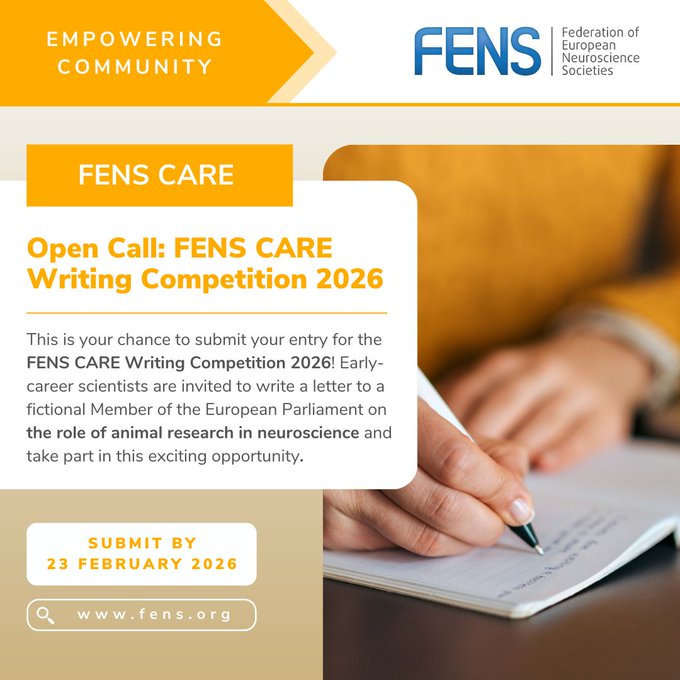
FENS is excited to announce that the Federation of European Neuroscience Societies Committee on Animals in Research (FENS CARE) now calls for:
Letters to a fictional Member of the European Parliament (MEP) to convince them to support the continued use of animals in neuroscience research.
FENS CARE announces the second edition of its writing competition for early-career scientists to contribute their insights and perspectives on animal experiments in brain research.
Animal experimentation has been a longstanding practice in scientific research, contributing to numerous advancements in medicine, biology, and other fields. However, the ethical implications and evolving alternative methods have raised questions about the continued necessity of animal experiments.
Invited are passionate and innovative students and early-career scientists to contribute to this crucial topic and win a prize of EUR 1000. Additionally, outstanding contributions will be considered for publication in the FENS society journal, the European Journal of Neuroscience, will be advertised on the FENS website and will be presented during the coming FENS Forum in Barcelona, 6-10 July 2026.
Points to consider addressing:
- How can researchers balance the potential benefits of animal experimentation in brain research with ethical concerns and animal welfare?
- Can you provide specific examples of crucial scientific advancements in brain research that resulted from animal experimentation?
- How do researchers in neuroscience determine the scientific necessity of using animals in their studies?
- Can emerging technologies offer more ethical and effective alternatives to animal testing in certain research areas?
- What are the current limitations of alternative methods, and how can they be addressed?
- How do different countries and cultures approach the ethical considerations of animal experimentation?
- What efforts can be made to improve public understanding of the ethical considerations and scientific necessity of animal experimentation?
Bear in mind that you address your letter to politicians who may have limited to no scientific knowledge.
Eligibility
Applicants must be Early-Career Researchers (ECRs).
ECRs are defined as postgraduate students undertaking MSc, MD, PhD, or assistant/trainee in the clinical sciences. A valid student/trainee enrolment form (or letter on official letterhead) is required to prove eligibility. Applicant name, institution name, and enrolment status must be indicated.
Researchers within the first five years of completing their highest degree (e.g., BSc, MSc, MD, PhD, or other professional doctorate) or, for clinical psychologists, the first five years after starting work as a clinical psychologist are eligible. A copy or photograph of the diploma (or letter on official letterhead) is required to prove eligibility. Applicant name, institution name, and graduation date must be indicated. This five-year period will be extended in case of maternity leave or other justifiable leaves of absence.
Submitting you application:
Applicants are invited to submit the following documents to care@fens.org by
23 February 2026 at 17:00 CET:
- Documents to prove eligibility
- The letter should be in PDF format, max. 1000 words (excluding references)
The winners will be notified before 3 March 2026. We look forward to receiving your applications, contributing to the ongoing dialogue on the role of animal experimentation in scientific research and hosting an insightful Forum on this crucial and sensitive subject. For further information, contact: care@fens.org.
 zurück